
Publications
SurGe: Improved Surface Geometry in Point Maps

Recent feedforward 3D reconstruction methods predict point maps and estimate global 3D geometry remarkably well. However, their predictions still exhibit inaccurate local surface geometry, which is clearly visible qualitatively but only weakly reflected in common metrics. To make these errors more explicit in evaluation, we introduce a point map normal metric that evaluates the local surface orientation induced by neighboring 3D predictions. To reduce these errors, we propose two complementary components: a point gradient matching loss that supervises depth-normalized 3D finite differences, and a Neighborhood Attention Decoder (NAD) that progressively upsamples features and uses Neighborhood Attention for local feature mixing. Across eight zero-shot monocular geometry benchmarks, our model, SurGe, achieves the best average rank for global point map AbsRel and consistently improves local point map and point map normal evaluations.
@inproceedings{knaebel2026surge,
title = {{SurGe}: Improved Surface Geometry in Point Maps},
author = {Knaebel, Karim and Martin Garcia, Gonzalo and Schmidt, Christian and Fradlin, Ilya and Nunes, Lucas and de Geus, Daan and Leibe, Bastian},
year = 2026,
booktitle = {Advances in Neural Information Processing Systems},
}
LVMT: Video Mask Transformer for Long-term Video Segmentation
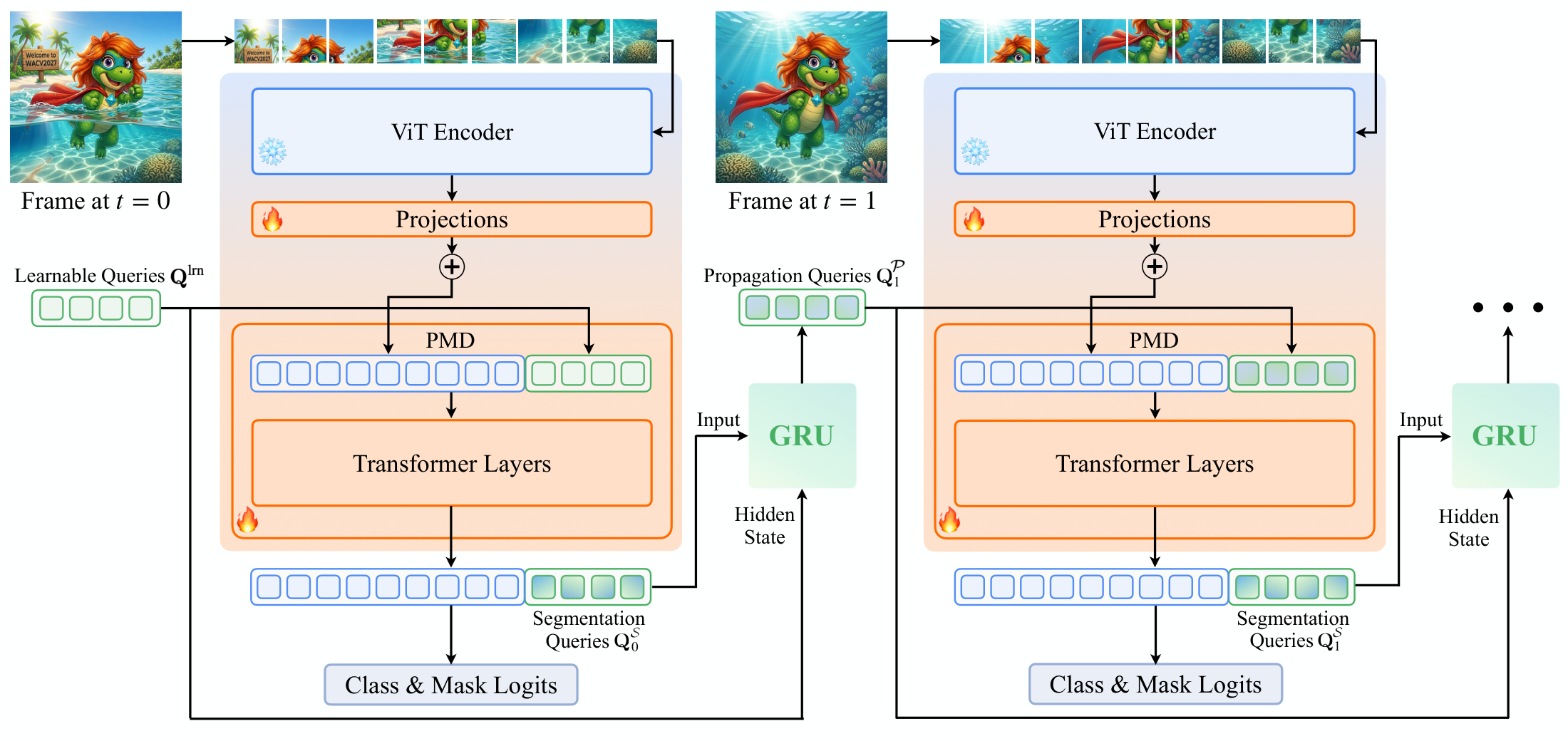
Existing online video segmentation methods struggle to track objects in long, complex videos with long-term occlu- sions. We hypothesize that this limitation is caused by (i) the inability of their temporal propagation mechanism to adaptively select the object information that is propagated across time, and (ii) their inability to be trained on long videos due to memory requirements and vanishing gradi- ents. To address the first limitation, we propose to use a lightweight GRU-based temporal propagation module that can learn to select which information it keeps in memory and propagates across time. Second, to allow training on long videos, we leverage Truncated Query Propagation (TQP), a training strategy in which the model processes a video in chunks of frames, where information about tracked objects is propagated between chunks but backpropagation is only conducted in individual chunks, enabling longer temporal supervision without out-of-memory issues, inference over- head, or vanishing gradients. The resulting model is called the Long-term Video Mask Transformer (LVMT). Extensive experiments on six benchmarks show that LVMT sets a new state of the art across a range of video segmentation tasks, while retaining the speed of the highly efficient model it is based on, making it 10×faster than the prior state of the art.
@article{Norouzi2026LVMT,
author = {Norouzi, Narges and Cavagnero, Niccol\`{o} and Zulfikar, Idil and Leibe, Bastian and Dubbelman, Gijs and {de Geus}, Daan},
title = {{LVMT: Video Mask Transformer for Long-term Video Segmentation}},
journal = {arXiv},
year = {2026},
}
Volume Transformer: Revisiting Vanilla Transformers for 3D Scene Understanding

Transformers have become a common foundation across deep learning, yet 3D scene understanding still relies on specialized backbones with strong domain priors. This isolates the field from the broader Transformer ecosystem, limiting the transfer of research advances from other domains and the benefits of increasingly optimized software and hardware stacks. To bridge this gap, we propose the Volume Transformer (Volt), which adapts the vanilla Transformer encoder to 3D scenes with minimal modifications. Specifically, Volt partitions 3D scenes into volumetric patch tokens, processes them with full global self-attention, and injects positional information via 3D rotary positional embeddings (RoPE). Our initial experiments reveal that naively training Volt on standard 3D benchmarks leads to poor generalization, highlighting the limited scale of current 3D supervision. To overcome this, we introduce a data-efficient training recipe based on strong 3D augmentations, regularization, and distillation from a convolutional teacher, making Volt competitive with state-of-the-art methods. We then scale supervision through joint training on multiple datasets and show that Volt benefits more from increased scale than domain-specific 3D backbones, achieving state-of-the-art results on several indoor and outdoor semantic segmentation benchmarks. Finally, as a drop-in backbone in a standard 3D instance segmentation pipeline, Volt also sets a new state of the art, highlighting its potential as a simple, scalable, and general-purpose backbone for 3D scene understanding.
Towards Metric-Agnostic Trajectory Forecasting

Accurate trajectory forecasting of surrounding traffic participants is a core capability for autonomous driving, enabling vehicles to anticipate behavior and plan safe maneuvers. We observe that current state-of-the-art forecasting models on Argoverse 2 and the Waymo Open Motion Dataset tailor their training objectives to the different benchmark metrics. Because these metrics encourage conflicting behavior, we propose a paradigm change for trajectory forecasting: training models with metric-agnostic probabilistic objectives and treating metric optimization as a downstream task applied to the predictive distribution. Concretely, we introduce Trajectory Distribution Evaluation (TraDiE) policies, metric-specific policies that map a predictive distribution to the set of K trajectories and confidences required by trajectory forecasting metrics. We evaluate this framework by introducing DONUT-NLL, which adapts the training objective of the state-of-the-art trajectory forecasting model DONUT to directly optimize the predictive distribution. Using our policies, DONUT-NLL achieves state-of-the-art results on all metrics of the Waymo motion prediction benchmark.
@inproceedings{knoche2026tradie,
title = {{Towards Metric-Agnostic Trajectory Forecasting}},
author = {Knoche, Markus and de Geus, Daan and Leibe, Bastian},
booktitle = {ECCV},
year = {2026}
}
Block-Sparse Global Attention for Efficient Multi-View Geometry Transformers
Efficient and accurate feed-forward multi-view reconstruction has long been an important task in computer vision. Recent transformer-based models like VGGT, $\pi^3$ and MapAnything have demonstrated remarkable performance with relatively simple architectures. However, their scalability is fundamentally constrained by the quadratic complexity of global attention, which imposes a significant runtime bottleneck when processing large image sets. In this work, we empirically analyze the global attention matrix of these models and observe that the probability mass concentrates on a small subset of patch-patch interactions corresponding to cross-view geometric correspondences. Building on this insight and inspired by recent advances in large language models, we propose a training-free, block-sparse replacement for dense global attention, implemented with highly optimized kernels. Our method accelerates inference by more than 3x while maintaining comparable task performance. Evaluations on a comprehensive suite of multi-view benchmarks demonstrate that our approach seamlessly integrates into existing global attention-based architectures such as VGGT, $\pi^3$, and MapAnything, while substantiallyimproving scalability to large image collections.
VidEoMT: Your ViT is Secretly Also a Video Segmentation Model

Existing online video segmentation models typically combine a per-frame segmenter with complex specialized tracking modules. While effective, these modules introduce significant architectural complexity and computational overhead. Recent studies suggest that plain Vision Transformer (ViT) encoders, when scaled with sufficient capacity and large-scale pre-training, can conduct accurate image segmentation without requiring specialized modules. Motivated by this observation, we propose the Video Encoder-only Mask Transformer (VidEoMT), a simple encoder-only video segmentation model that eliminates the need for dedicated tracking modules. To enable temporal modeling in an encoder-only ViT, VidEoMT introduces a lightweight query propagation mechanism that carries information across frames by reusing queries from the previous frame. To balance this with adaptability to new content, it employs a query fusion strategy that combines the propagated queries with a set of temporally-agnostic learned queries. As a result, VidEoMT attains the benefits of a tracker without added complexity, achieving competitive accuracy while being 5x--10x faster, running at up to 160 FPS with a ViT-L backbone.
@inproceedings{norouzi2026videomt,
author={Norouzi, Narges and Zulfikar, Idil and Cavagnero, Niccol\`{o} and Kerssies, Tommie and Leibe, Bastian and Dubbelman, Gijs and {de Geus}, Daan},
title={{VidEoMT: Your ViT is Secretly Also a Video Segmentation Model}},
booktitle={Proceedings of the IEEE/CVF Conference on Computer Vision and Pattern Recognition (CVPR)},
year={2026}
}
DINO in the Room: Leveraging 2D Foundation Models for 3D Segmentation

Vision foundation models (VFMs) trained on large-scale image datasets provide high-quality features that have significantly advanced 2D visual recognition. However, their potential in 3D scene segmentation remains largely untapped, despite the common availability of 2D images alongside 3D point cloud datasets. While significant research has been dedicated to 2D-3D fusion, recent state-of-the-art 3D methods predominantly focus on 3D data, leaving the integration of VFMs into 3D models underexplored. In this work, we challenge this trend by introducing DITR, a generally applicable approach that extracts 2D foundation model features, projects them to 3D, and finally injects them into a 3D point cloud segmentation model. DITR achieves state-of-the-art results on both indoor and outdoor 3D semantic segmentation benchmarks. To enable the use of VFMs even when images are unavailable during inference, we additionally propose to pretrain 3D models by distilling 2D foundation models. By initializing the 3D backbone with knowledge distilled from 2D VFMs, we create a strong basis for downstream 3D segmentation tasks, ultimately boosting performance across various datasets.
@InProceedings{knaebel2025ditr,
title = {{DINO} in the Room: Leveraging {2D} Foundation Models for {3D} Segmentation},
author = {Knaebel, Karim and Yilmaz, Kadir and de Geus, Daan and Hermans, Alexander and Adrian, David and Linder, Timm and Leibe, Bastian},
booktitle = {2026 International Conference on 3D Vision (3DV)},
year = {2026}
}
Biased Dreams: Limitations to Epistemic Uncertainty Quantification in Latent Dynamics Models

Model-based reinforcement learning distinguishes between dynamics models operating on proprioceptive states and latent dynamics models typically operating on high-dimensional image observations. Among the latter, Dreamer's Recurrent State Space Model (RSSM) has emerged as a dominant architecture. While ensemble-based epistemic uncertainty has proven effective in proprioceptive dynamics for mitigating model exploitation, guiding exploration, or promoting caution, its behavior in latent dynamics remains largely unexplored. Our experiments reveal that although ensemble disagreement captures local epistemic uncertainty, it does not reliably reflect global compounding model error accumulated over prolonged RSSM latent rollouts. We provide evidence for an attractor behavior that draws rollouts toward well-supported latent regions, where uncertainty diminishes despite increasing discrepancies from the true environment dynamics. This can cause the model to overestimate returns when attractor regions correspond to high-reward behaviors. Our findings reveal a structural limitation of epistemic uncertainty estimation in RSSMs and challenge the assumption that epistemic uncertainty estimation transfers directly from proprioceptive to latent dynamics.
Previous Year (2025)
